

Rock drilling tools include drill bits, drill rods, coupling sleeves, shank adapters, etc., which are used to drill blastholes in rocks. The shank adapter is a bridge connecting the rock drill rig and the drill rod, used to transmit the impact energy and rotation torque of the rock drill.
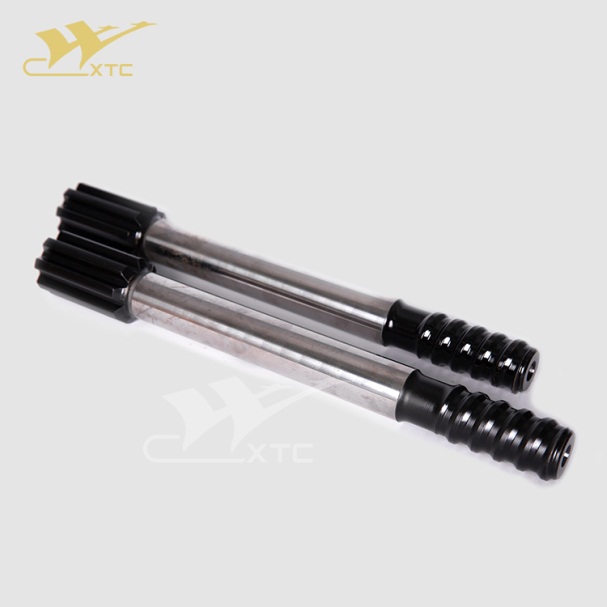
As the key connecting part between drill rig and drilling tools, its processing quality directly affects the energy transfer efficiency and tools life. The following are some manufacturing key points:
1. Material selection
High-strength alloy steel: such as 23CrNi3Mo, 35CrMnSiA, must have high fatigue resistance and impact toughness.
Heat treatment process: overall carburizing, quenching heat treatment to ensure the core and surface hardness.
2. Key structure processing
Tail end face:
The flatness error is ≤0.05mm, ensuring a perfect fit with the rock drill piston to avoid impact energy loss.
Surface roughness Ra≤1.6μm, reducing friction loss.
Spline/hexagonal drive unit:
Using CNC milling or broaching, the tooth profile symmetry is ≤0.1mm, ensuring torque transmission without unbalanced load.
3. Geometric tolerance control
Coaxiality: The coaxiality between the drive part and the tail end is ≤φ0.1mm to prevent eccentric vibration.
Verticality: The verticality between the end face and the axis is ≤0.05mm/100mm.
4. Surface treatment
Shot Peening: Improves fatigue life, especially in shock loaded areas.
Phosphating/galvanizing: Anti-rust treatment to extend the underground service life.
5. Key points of testing
Ultrasonic flaw detection: no internal defects such as cracks and inclusions.
Hardness gradient test: The hardness from the surface to the core needs to transition smoothly.