

I. Advantages of Surface Post-Treatment for Cemented Carbide Buttons
During drilling operations with Down-the-Hole (DTH) drill bits in high-hardness (rock hardness coefficient f = 14-16 and highly abrasive rock formations, cemented carbide buttons are continuously subjected to severe impact loading, cutting action, and abrasive wear caused by hard rock.
Conventional manufacturing processes generally result in carbide buttons with unfavorable surface stress conditions, insufficient surface layer densification, and relatively low fracture toughness. Under continuous cyclic loading, microcracks readily initiate and propagate, leading to failure modes such as button chipping, fracture, and excessive wear, ultimately resulting in premature failure of the DTH drill bit. Frequent bit replacement not only significantly increases consumable costs for mining operations but also adversely affects production continuity and operational efficiency.
Unlike conventional approaches that primarily focus on optimizing carbide composition or adjusting sintering parameters, which often provide only limited performance improvements, surface post-treatment technology enhances the microstructure and stress state of the surface layer through mechanical surface plastic deformation. This fundamentally improves the wear resistance and fracture resistance of cemented carbide buttons.
The major advantages are as follows:
(1) Performance enhancement without changing the substrate material
The process does not require any modification to the composition of the carbide substrate. Instead, substantial performance improvements are achieved through mechanical strengthening of the surface layer.
(2) Optimization of surface stress state
A stable residual compressive stress layer is introduced to effectively offset alternating tensile stresses generated during drilling operations. This suppresses the initiation and propagation of surface microcracks, enhances resistance to fatigue impact, and reduces the risk of brittle fracture under instantaneous impact loading.
(3) Increased surface hardness and wear resistance
Mechanical strengthening densifies the relatively porous surface structure of the carbide button while refining the carbide grain structure, thereby forming a dense, high-hardness strengthened surface layer with superior wear and erosion resistance.
(4) Improved fracture toughness (KIC)
Mechanical strengthening repairs original microscopic surface defects, optimizes the surface stress field, and blunts crack tips, effectively inhibiting crack propagation and significantly improving the fracture toughness (KIC) of the cemented carbide buttons.
II. Comparative Test
1. Test Conditions
The field test was conducted at a large domestic tungsten-molybdenum mine. The ore body consisted of dense, hard tungsten-molybdenum ore with a rock hardness coefficient of f = 14-16. The formation exhibited excellent integrity and extremely high abrasiveness, representing one of the most demanding drilling environments with severe drill bit wear.
2. Test Results

During drilling operations with Down-the-Hole (DTH) drill bits in high-hardness (rock hardness coefficient f = 14-16 and highly abrasive rock formations, cemented carbide buttons are continuously subjected to severe impact loading, cutting action, and abrasive wear caused by hard rock.
Conventional manufacturing processes generally result in carbide buttons with unfavorable surface stress conditions, insufficient surface layer densification, and relatively low fracture toughness. Under continuous cyclic loading, microcracks readily initiate and propagate, leading to failure modes such as button chipping, fracture, and excessive wear, ultimately resulting in premature failure of the DTH drill bit. Frequent bit replacement not only significantly increases consumable costs for mining operations but also adversely affects production continuity and operational efficiency.
Unlike conventional approaches that primarily focus on optimizing carbide composition or adjusting sintering parameters, which often provide only limited performance improvements, surface post-treatment technology enhances the microstructure and stress state of the surface layer through mechanical surface plastic deformation. This fundamentally improves the wear resistance and fracture resistance of cemented carbide buttons.
The major advantages are as follows:
(1) Performance enhancement without changing the substrate material
The process does not require any modification to the composition of the carbide substrate. Instead, substantial performance improvements are achieved through mechanical strengthening of the surface layer.
(2) Optimization of surface stress state
A stable residual compressive stress layer is introduced to effectively offset alternating tensile stresses generated during drilling operations. This suppresses the initiation and propagation of surface microcracks, enhances resistance to fatigue impact, and reduces the risk of brittle fracture under instantaneous impact loading.
(3) Increased surface hardness and wear resistance
Mechanical strengthening densifies the relatively porous surface structure of the carbide button while refining the carbide grain structure, thereby forming a dense, high-hardness strengthened surface layer with superior wear and erosion resistance.
(4) Improved fracture toughness (KIC)
Mechanical strengthening repairs original microscopic surface defects, optimizes the surface stress field, and blunts crack tips, effectively inhibiting crack propagation and significantly improving the fracture toughness (KIC) of the cemented carbide buttons.
II. Comparative Test
1. Test Conditions
The field test was conducted at a large domestic tungsten-molybdenum mine. The ore body consisted of dense, hard tungsten-molybdenum ore with a rock hardness coefficient of f = 14-16. The formation exhibited excellent integrity and extremely high abrasiveness, representing one of the most demanding drilling environments with severe drill bit wear.
2. Test Results
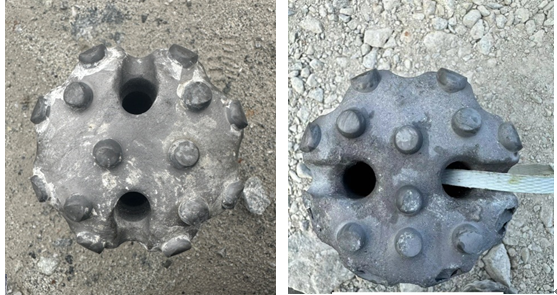
Cemented Carbide Post-processing:
Standard Cemented Carbide:
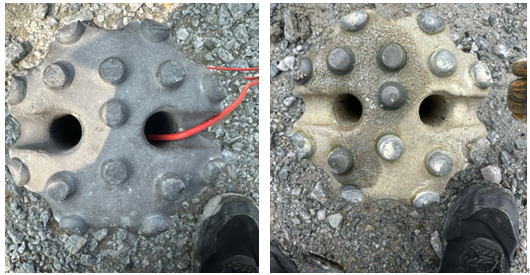
Compared with standard cemented carbide, post-processed carbide achieves a 10% increase in overall drill bit service life, more stable drilling performance, higher penetration efficiency and 20% reduction in button fracture rate.
III. Conclusion
Surface post-treatment technology enhances the surface layer of cemented carbide buttons through mechanical strengthening and plastic deformation, effectively optimizing both their mechanical properties and surface stress state. As a result, the wear resistance and impact toughness of DTH drill bit carbide buttons are fundamentally improved, effectively addressing the primary failure mechanisms of rapid wear and button fracture encountered in high-hardness rock formations.